www.unik77.tk
all about unik 77 : percaya atau tidak, kalau bisa sih unik setuju ?

sumber :http://silverfishattack.blogspot.com/2009/01/salamander-spotlight-3-living-families.html

Emperor Newt (Tylototriton shanjing) - SE Asia
family Salamandridae
As part of my ongoing mania over salamanders (Order Caudata), I thought it might be worth showing a cursory gallery of the families of salamanders. Before we do though, 3 facts:
- The main Biodiversity Hotspot for salamanders in the world is in the South Eastern United States, especially the area of the Southern Appalachians.
- Again, salamanders (which are Amphibians) are not lizards (which are Reptiles).
- Salamanders are the only group of vertebrates that can regenerate lost limbs.
.........................................................................................................
Family Cryptobranchidae - Giant Salamanders

Hellbender (Cryptobranchus alleganiensis) - Eastern United States

Japanese Giant Salamander (Andrias japonicus)

Chinese Giant Salamander (A. davidianus)
Family Hynobiidae - Asiatic Salamanders

Oita Salamander (Hynobius dunni) - Japan

Siberian Salamander (Salamandrella keyserlingii)
Family Ambystomatidae - Mole Salamanders

Marbled Salamander (Ambystoma opacum) - Eastern U.S.

California Tiger Salamander (A. californiense)

Northwestern Salamander (A. gracile) - NW U.S.

Axolotl or Ajolote (A. mexicanum) - Mexico
Family Dicamptodonidae - Pacific Giant Salamanders

Pacific Giant Salamander (Dicamptodon tenebrosus)

California Giant Salamander (Dicamptodon ensatus)

juvenile Cope's Giant Salamander (Dicamptodon copei)
Family Aphiumidae - Amphiumas

Three-toed Amphiuma (Amphiuma tridactylum)

Two-toed Amphiuma (A. means)

One-toed Amphiuma (A. pholeter)
Family Plethodontidae - Lungless Salamanders

Yonahlossee Salamander (Plethodon yohnahlossee) - Ea. U.S.

Cave Salamander (Eurycea lucifuga) - Ea. & Cen. U.S.

Northern Red Salamander (Pseudotriton ruber) - Ea. U.S.
feeding on insect

Grotto Salamander (Typhlotriton spelaeus) - Ea. U.S.

Yellow-blotched Ensatina (Ensatina enscholtzii croceater) - California

Bolitoglossa striatula - Central America

Bolitoglossa sp. - Guatamala

Texas Blind Cave Salamander (Typhlomolge rathbuni)
Family Proteidae - Waterdogs and Mudpuppies

Common Mudpuppy (Necturus maculosus) - NE U.S.

Gulf Coast Waterdog (N. beyeri) - SE U.S.

Olm (Proteus anguinis) - Southern Europe
Family Rhyacotritonidae - Torrent Salamanders

Cascade Torrent Salamander (Rhyacotriton cascadae) - NW U.S.

NW United States
Family Salamandridae - Newts

Oregon Newt (Taricha torosa)

Peninsula Newt (Notophthalmus viridescens piaropicola) - Florida

Red Spotted Newt (N. v. viridescens)
Red Eft stage (middle stage juvenile)

Marbled Newts (Triturus marmoratus) - France and Spain

Japanese Firebelly Newt (Cynops pyrrhogaster)

Fire Salamander (Salamandra salamandra) - Europe

Imperial Cave Salamander (Speleomantes imperialis) - Italy
Family Sirenidae - Sirens

Lesser Siren (Siren intermedia) - Ea. U.S.

Southeastern U.S.

Southeastern U.S.

Barred Tiger Salamander (Ambystoma tigrinum mavortium)
If you look around, a lot of people use the word "salamander" for animals, which often, are not actually salamanders. This begs the question then, "what is a salamander?" Let's start off with the idea that THEY ARE NOT LIZARDS! Now we can proceed...
They are Amphibians (not Reptiles):
- Slimy skin, without scales
- No teeth, nor claws
- Eggs without shells, laid in water
- Young are Larvae (tadpoles) and undergo metamorphosis into adult reproductive form
- Ectothermic ("cold blooded")
- none are Marine (salt water)

Egg Mass of Spotted Salamander (Ambystoma maculatum)

Larva of Marbled Salamander (A. opacum)
Salamanders:
- Order Urodela ( or CAUDATA)
- Salamander larvae have external gills, which most lose during metamorphosis.
- Some adults have lungs, and some breathe only through the skin and mouth lining. Some retain their external gills through adulthood (utilizing oxygen from both air and water).
- Some have lizard like bodies, and some are rather eel like (lacking all 4 limbs).
- Adults are usually Carnivorous.

Texas Blind Cave Salamander (Typhlomolge rathbuni)

Wednesday, January 7, 2009
Salamander Spotlight #1 - LESSER SIREN (Siren intermedia)
* This post is for my friend Mark, whose dedication to troubled salamanders is well known in herpetological psychology circles.

The Lesser Siren is a completely aquatic salamander, that retains its external gills through adulthood. They feed on a variety of aquatic invertebrates and small vertebrates.

The long slender body of the Siren has led to names like "Mud Eel". The Siren, unlike eels, do have a pair of small front legs, but no hind legs.

Sirens are widely distributed through the Eastern U.S. and Northern Mexico, yet are seldom seen. They prefer to dwell in the muddy bottoms and tangles of dense aquatic vegetation of small bodies of fresh water.

Siren intermedia wuv you!!! It is believed that their love for each other can be quite violent though, as courtship related abrasions and injuries are sometimes observed. They may also be rather vehement in the defense of their eggs, as the female stays with them until hatching.
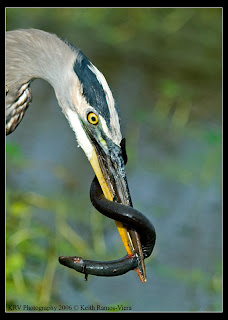
An unfortunate Lesser Siren falling prey to a Great Blue Heron

A researcher carefully studies slimy sirens, which can actually deliver nasty bites with their sharp bony untoothed jaws. Lesser Sirens may reach up to about a foot long.

The hatchling larval Siren hiding in floating water plants is only half an inch in length, and display rather more fanciful external gills.

The Lesser Siren is a completely aquatic salamander, that retains its external gills through adulthood. They feed on a variety of aquatic invertebrates and small vertebrates.

The long slender body of the Siren has led to names like "Mud Eel". The Siren, unlike eels, do have a pair of small front legs, but no hind legs.

Sirens are widely distributed through the Eastern U.S. and Northern Mexico, yet are seldom seen. They prefer to dwell in the muddy bottoms and tangles of dense aquatic vegetation of small bodies of fresh water.

Siren intermedia wuv you!!! It is believed that their love for each other can be quite violent though, as courtship related abrasions and injuries are sometimes observed. They may also be rather vehement in the defense of their eggs, as the female stays with them until hatching.

An unfortunate Lesser Siren falling prey to a Great Blue Heron

A researcher carefully studies slimy sirens, which can actually deliver nasty bites with their sharp bony untoothed jaws. Lesser Sirens may reach up to about a foot long.

The hatchling larval Siren hiding in floating water plants is only half an inch in length, and display rather more fanciful external gills.
No comments:
Post a Comment